
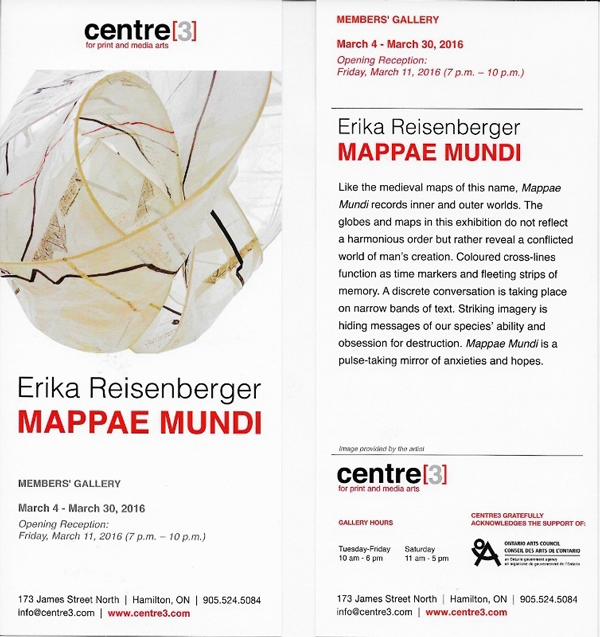
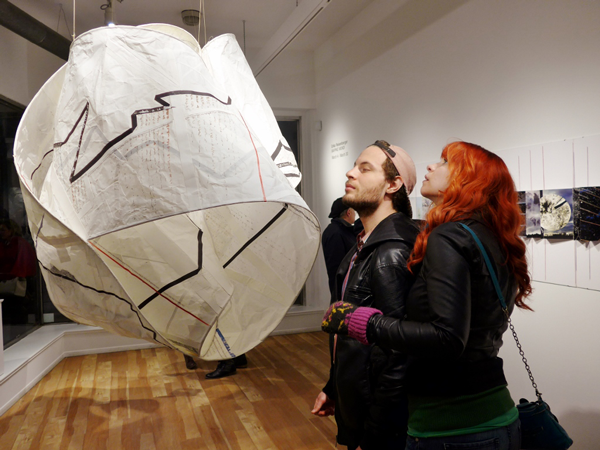
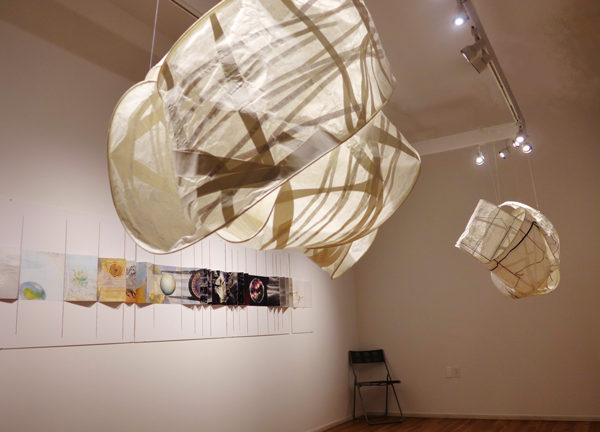
WAVEFORM – new work for an exhibition at Centre3, Hamilton, March 2016
The SOUND: Short bits of sound (1/2 – 3 seconds) separated by 1 – 8 seconds of silence. A similar, sound environment you find on the soundtrack for Sequence.
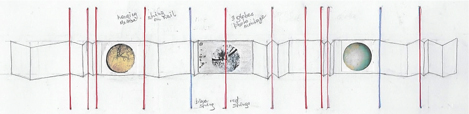
WAVEFORM
It is a strip of paper 12” high and folded in irregular, rhythmic fashion, similar to my Flight Path pieces.
The strip hangs on the wall suspended by red strings which are part of the piece. It mimics the sound environment and is supported by it. The surface shows map fragments, multi-language text fragments, layered or ink covered images, burn marks. Globes (photomontage) occupy the strip with their messages of violent change (reminiscent of Empire). Paper is the material I like to use for its translucency, for its denial of permanence, mass and weight -supporting aspects of transience and change.
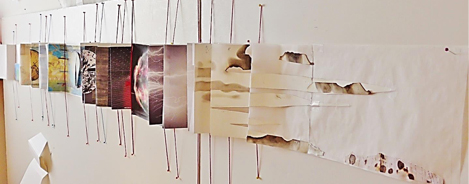
WAVEFORM mock up, scale 1:2
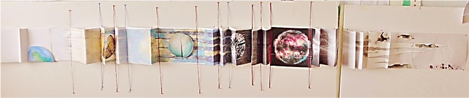
PAPIER GLOBAL PAPER
International Paper Art Triennal 2015
Exhibition with 90 artists from 14 different countries
Stadtgalerie im Stadtmuseum und Handwerksmuseum Deggendorf
May 16, 2015 - October 18, 2015
The Museum of the City of Deggendorf are presenting for the third time a large-scale exhibition of international paper art under the title "Global Paper". More than 400 artists from 28 countries submitted entries for the Deggendorf show, over 100 more than for the last triennial. Deggendorf has thus in the meantime become a prominent centre for paper art from all over the world. For the International Paper Art Triennial 2015 the jury selected 90 artists from 14 different countries whose work will be on view across 450 metres of exhibition space at the city's Stadtgalerie im Stadtmuseum and Handweksmuseum. The Standtmuseum with its Stadtgalerie dedicated to contemporary art and adjacent Handwerksmuseum with it's crafts-centred approach provide the ideal setting for a show of this kind.
ART AS THE NEW STEEL
Group show at the Workers Arts & Heritage Centre
May 9th to August 30th, 2014
.jpg)
 THE SEQUENCE
About the exhibition at Hamilton Artists Inc. September, 2012
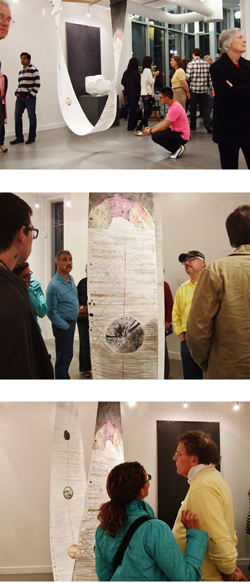
The exhibition at The Inc. was the first showing of the three pieces that make up The Sequence. The show was very well attended, particularly on the two days of the Super-crawl when we counted nine thousand people visiting the gallery –an artist’s dream!
I shared the bright, new exhibition space at the Inc. with Peter, a writer of short stories, who mounted a beautiful presentation of story excerpts and also did readings from his work. There was a whole lot of valuable feedback coming from the general public and also from members of the arts community. The middle piece of the SEQUENCE installation, called Empire, attracted most attention since, on closer inspection, much of the text could be read an aspect that made it also accessible to people who are not used to looking at ‘art’.
Most of my artist colleagues liked the abstract qualities of the two white pieces Promise and Hope. They remarked on the ‘ethereal other worldliness’ of the pieces. Thank you all!
SEQUENCE
an installation in three parts
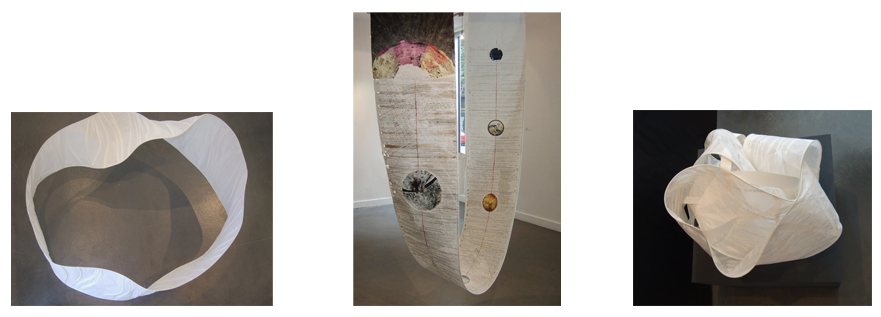
The three parts of SEQUENCE come together to present a metaphor for historical development and future possibilities. The three images depict the story of progression from - 1) PROMISE, the ingenuous, unspoiled, new – to 2) EMPIRE the controlling and oppressive organisation, and, in its final part - 3) HOPE a concept of acknowledgement and accommodation of multitude.
The common format of the three pieces is a strip of paper appr. 20"/50cm wide and 18 ft. /550cm long. The strip is reconnecting to itself with a half twist to form a 'Möbius Band'. It has only one endless surface and is often used as a symbol of eternity. ‘Empire’ does not reconnect, it is one-directional.
Promise is a horizontal loop of translucent vellum paper with a diameter of 6ft/183cm and is suspended from the ceiling. 'Promise', with delicate white on white folding marks, hovers in the room indicating innocence and lightness.
The second piece, Empire, is a vertical structure that transmits a strong tone of power and progression. Text fragments show the history of conquest and destruction in the waxing and waning of Empires and the human cost involved. Maps illustrate the widening perception of the world to its finality. ‘Empire’ is suspended from the ceiling in a big sweep.
On Empire follows the visionary image of Hope. This third piece reflects inclusion and pluralism. Narrow strips branch off and rejoin each other again. The paper band, showing unidentified symbols and markings, is wound together to form a ball-shape – a whole world.
A sound environment is being developed to add an element of time and change to the static visual presentation. By using intermittent sound bites separated by intervals of silence, the impact of this framed silence is added to the story.
The work on SEQUENCE was generously supported by an Ontario Arts Council Project Grant.
<< back to top>>
In her 2013 Hamilton Artist of the Year nomination Jane Adeney writes about her
favourite Emerging artist:
Erika Reisenberger is an emerging Hamilton artist who, having studied art in Europe decades ago, and been interrupted by the need to survive as an immigrant to Canada, has, in recent years, demonstrated courage and creativity in reinventing herself as a contemporary artist.
An active participant in Hamilton art life, she has been clarifying and defining her unique artistic voice within the context of contemporary practice .The body of work that is emerging is thoughtful, original, and consistent, not to mention beautiful.
She has begun actively seeking opportunities to show her work, with some success in Hamilton region, and I believe many more will follow.
PAPERWORK: Evelyn Kelch, Erika Reisenberger
Burlington Arts Centre, AIC Gallery,
Dec. 2010 - Jan. 2011
New abstracted paper work by these emerging artists. White, black, minimal colour... sculptural and two dimensional works. George Wale, Director of Programs, Burlington Art Centre
In this exhibition the works of Erika Reisenberger and Evelyn Kelch are linked by two elements: Both artists chose the simple, ubiquitous material of paper as their primary medium; and both artists have made the decision to leave aside brilliant colour for the stark and subtle tonalities bracketed by black and white. One might expect from these restrictions, works of sombre, Minimalist austerity. Instead, the economy of means resulted in artworks endowed with both conceptual complexity and formal ingenuity.
If Kelch's focus is the human figure and the here and now, ReisenBerger takes us into the world of landscape, history and memory. A native of Austria, the artist has lived in Canada for thirty years and has considered the duality of homelands to be an integral part of her life and her work. While pondering the importance of landscape in the building of identity, she realized that the water in the lakes of Canada had become as precious to her as the mountains of her homeland. On a flight to Europe, as she gazed through the window of the airplane, she noticed how distance abstracted the topography, emphasizing the patterns of waves and mountains. As a sculptor, she had often worked in clay and concrete. Now she felt the necessity to move away from the denseness of these materials which seemed both too banal and to unwieldy for her purpose. Paper became the perfect medium for capturing nature's rhythm.
"Giving form to a thin flat sheet gives some basic insight into the buckling of the earth's surface and to the complexity of wave patterns," she has written. She noted that the minutely pleated folds she made on the paper resembled drawings and that by gluing stained pieces of paper to the folded vellum, she could represent weather. The translucency of the paper invited her to underline it with maps. The faintly visible maps prompted ideas of digression, randomness, contingency, chance encounter and, of course, the road not taken.
The literal journey evolves into a powerful metaphor for the journey through life in her latest piece called 'The Journey: Möbius,Peutinger,Reisenberger Map.' The sculpture consists of a 22 foot long strip, the ends attached to each other with a half twist. This circular band, called a Mobius Band, has only one endless surface, one edge. As such it lacks any sort of orientability, no up and down, left or right and it is often used as a symbol of infinity. Reisenberger's Möbius Band has been inscribed with linear markings based on an old map called the Peutinger Map made by Alsatian monks circa 1265, itself based on copies from Roman era road maps dating back to 79 A.D. The Peutinger Map consists of 11 vellum sheets, measuring a total of 22 foot when put together.
History, as a journey with endless repetition, is a concept that has long interested Reisenberger. An earlier sculpture, called City Square (not on view in this exhibition), is a representation of an anonymous European plaza that includes figures clothed in different era dress, all congregated in the same space, at the same time. Here, the unsettling presence of the buried past is brought to light and the movement through time and history becomes part of the personal journey.
This idea is abstracted in The Journey allowing for a wider play of association and a more nuanced emotional expression. With its endless surface and road map markings the artwork brings to mind the famous words of T.S.Eliot in "Little Gidding", The Four Quartets:
"We shall not cease from exploration
And the end of all our exploring
Will be to arrive where we started
And know the place for the first time..." Elaine Hujer, Dec. 2010